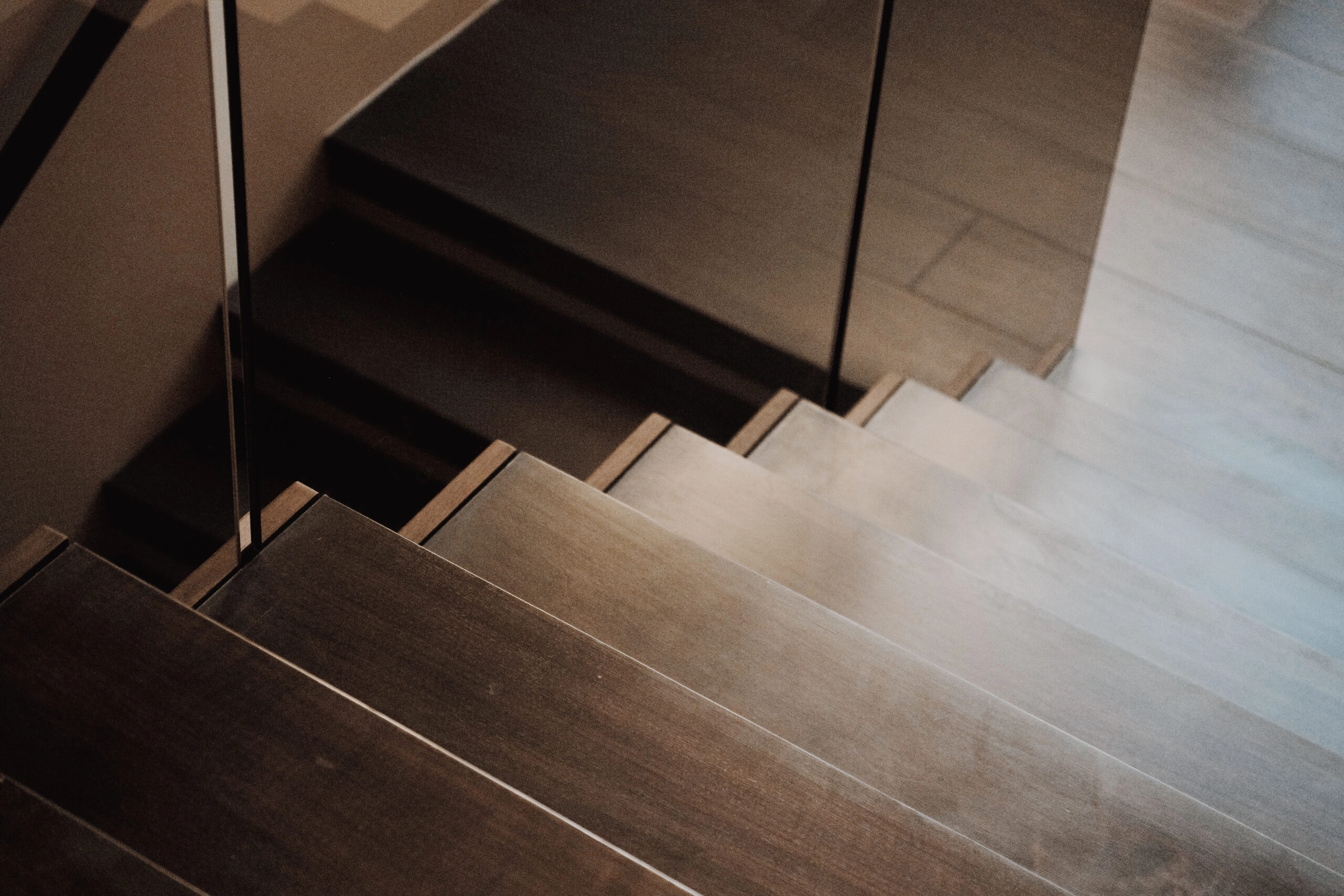
Close-up of wooden stairs viewed from above through a glass railing panel.
Stair Treads

Start with the tread.

Des Moines, Iowa
Underside of FLIGHT Stack treads, light wood stepping past glass railing and glass pendants

Custom treads cut for your unique staircase

Custom treads cut for your unique staircase

Custom treads cut for your unique staircase

Custom treads cut for your unique staircase

There is no stock size. You give us the length, depth, and thickness, and the tread is milled, glued, sanded, routed, and finished to those numbers in our woodshop in Goshen, Indiana. Choose from eight hardwood species. Order them unfinished if you want to match your floors on site, or stained and clearcoated in our finishing room. Treads, landing platforms, and replacement treads all come out of the same shop, in the same species and the same finish, so your whole staircase feels cohesive.
Modern wooden staircase with broad, flat steps and a glass railing reflecting the stairs and surroundings.
Five Tread Types

Start with the one that fits your stair

Start with the one that fits your stair

Start with the one that fits your stair

Start with the one that fits your stair

Signature Thick
Our thickest profile, with a continuous face and no visible glue lines. The choice when the tread is the thing you look at.

Butcher Block Thick
Strips turned on edge and face glued, so the grain runs across the face. More character, and the look most people picture on a floating stair.

Solid
A single thickness of hardwood, for traditional runs and thin profiles.

Replacement
For keeping your existing substructure. The new tread sits over what is already there, so you are not tearing the stair apart.

Landing
Wide, deep platforms for landings and mid-runs, matched to your treads in the same species and finish.
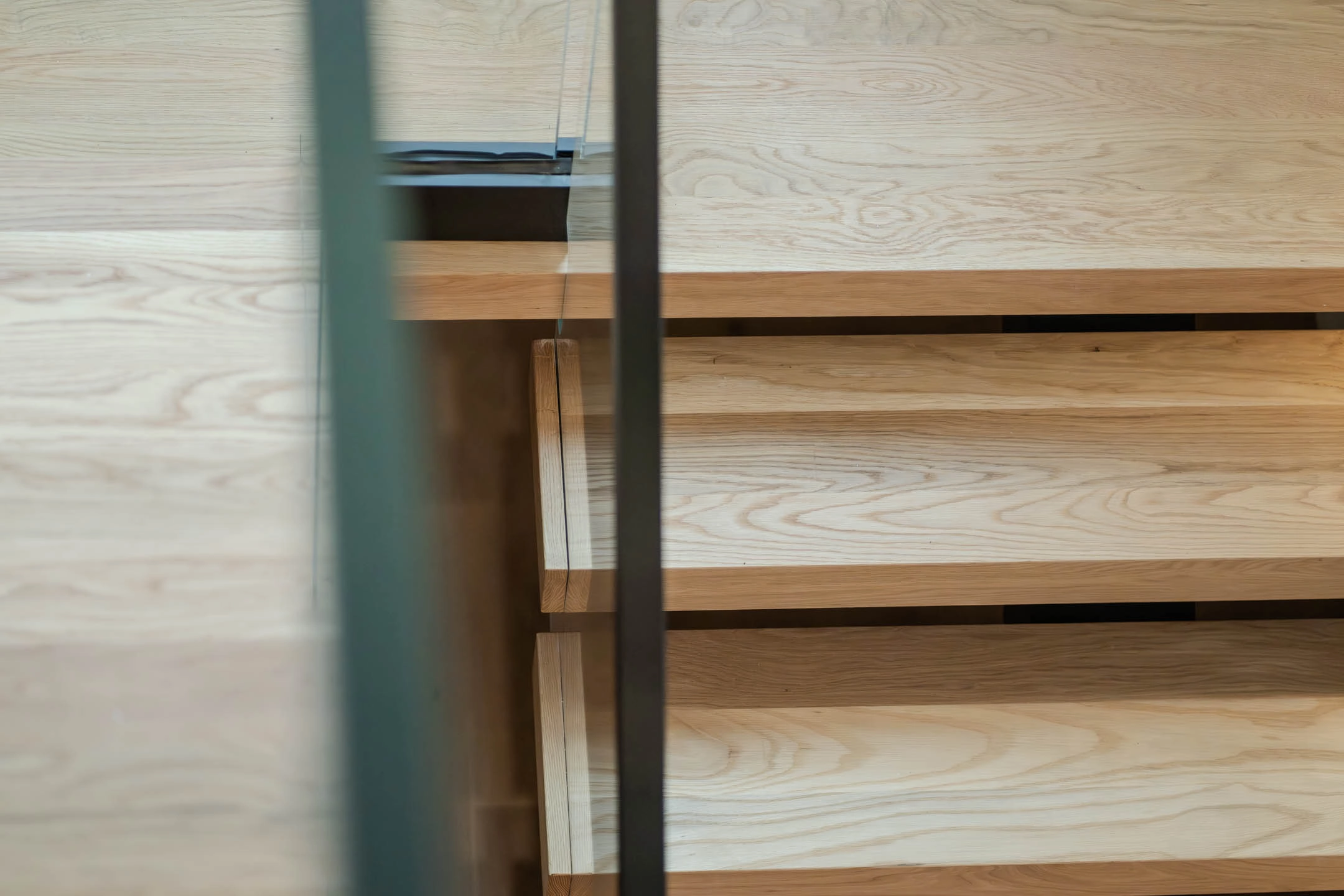
Oak treads seen from below, fixed to the black FLIGHT Mono stringer behind glass
How Our Treads Are Built

An engineered core under a hardwood face

An engineered core under a hardwood face

An engineered core under a hardwood face

An engineered core under a hardwood face

Our Standard and Signature treads are built on an engineered internal core with a hardwood wear layer over it. That is deliberate. A core that will not move keeps a wide tread flat across seasons, and the wear layer gives you the species and grain you actually see and walk on.

Species choice is not only about color. Hardness is measured on the Janka scale, and anything rated 900 or above holds up as tread material. Grain pattern matters too: Hickory and White Oak are well defined, Hard Maple is milder. And color runs from the high variation of Hickory and Walnut to the more even tone of Hard Maple and Oak.

Walking surfaces are finished with a conversion varnish, the same coating used in the hardwood flooring industry, because it is built for heavy use. Handrails and other frequently touched parts get a pre catalysed lacquer instead, which is made to stand up to the oils on your hands.
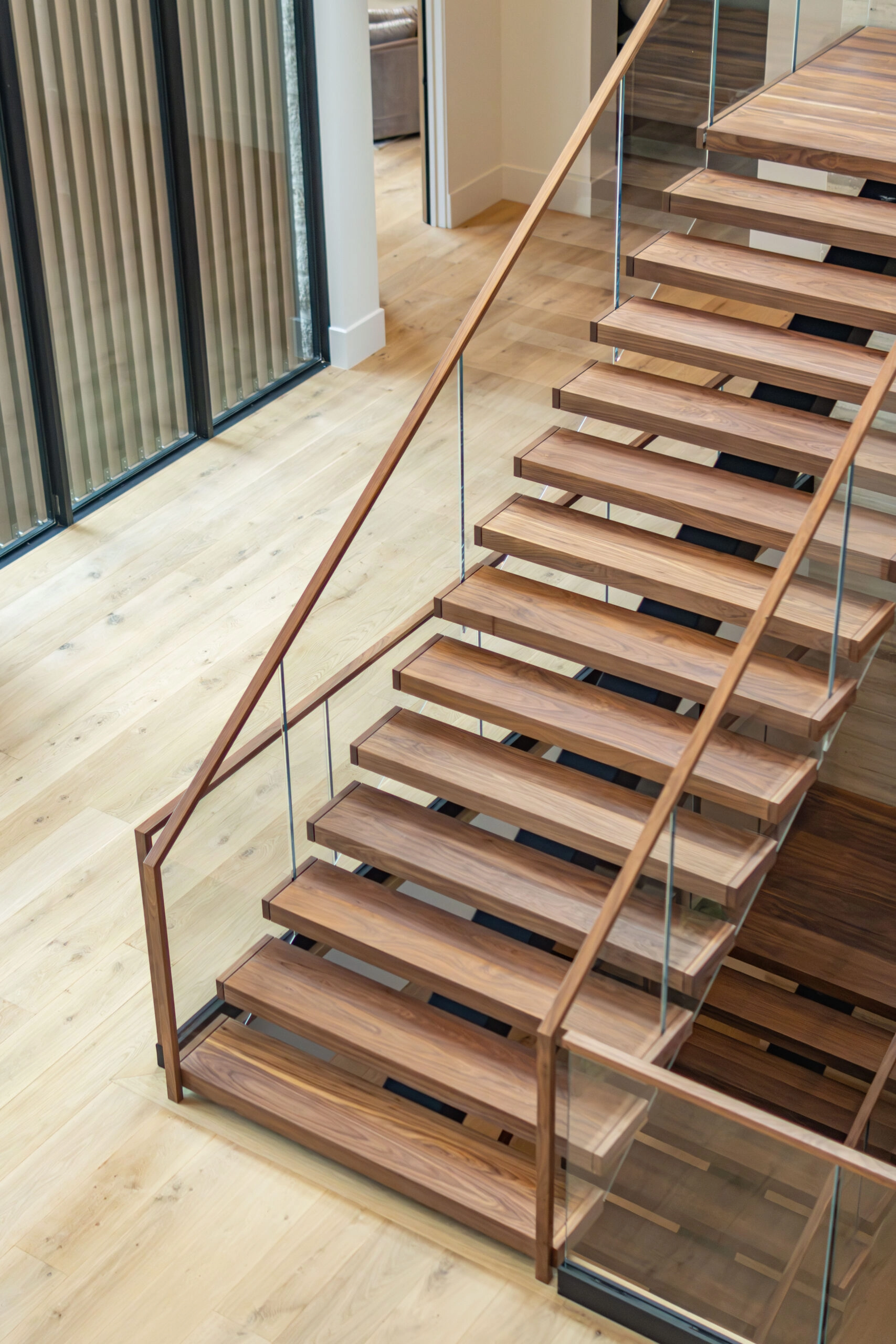
Walnut treads and a matching handrail on a FLIGHT Mono stair with glass railing
Sizing and Returns

Getting the dimensions right

Getting the dimensions right

Getting the dimensions right

Getting the dimensions right

Thickness
Standard profiles run 2 inch, 2 1/2 inch, 3 inch, 3 1/2 inch and 4 inch. The thicker profiles read best on open riser and floating stairs, where the edge of every tread is in view.

Width
Common widths run from 36 inches to 72 inches, and any length in between can be cut to your measurement.

Depth
Code sets the floor here. Tread depth cannot be less than 10 inches, and your run will usually call for more.

Thin Tread Returns
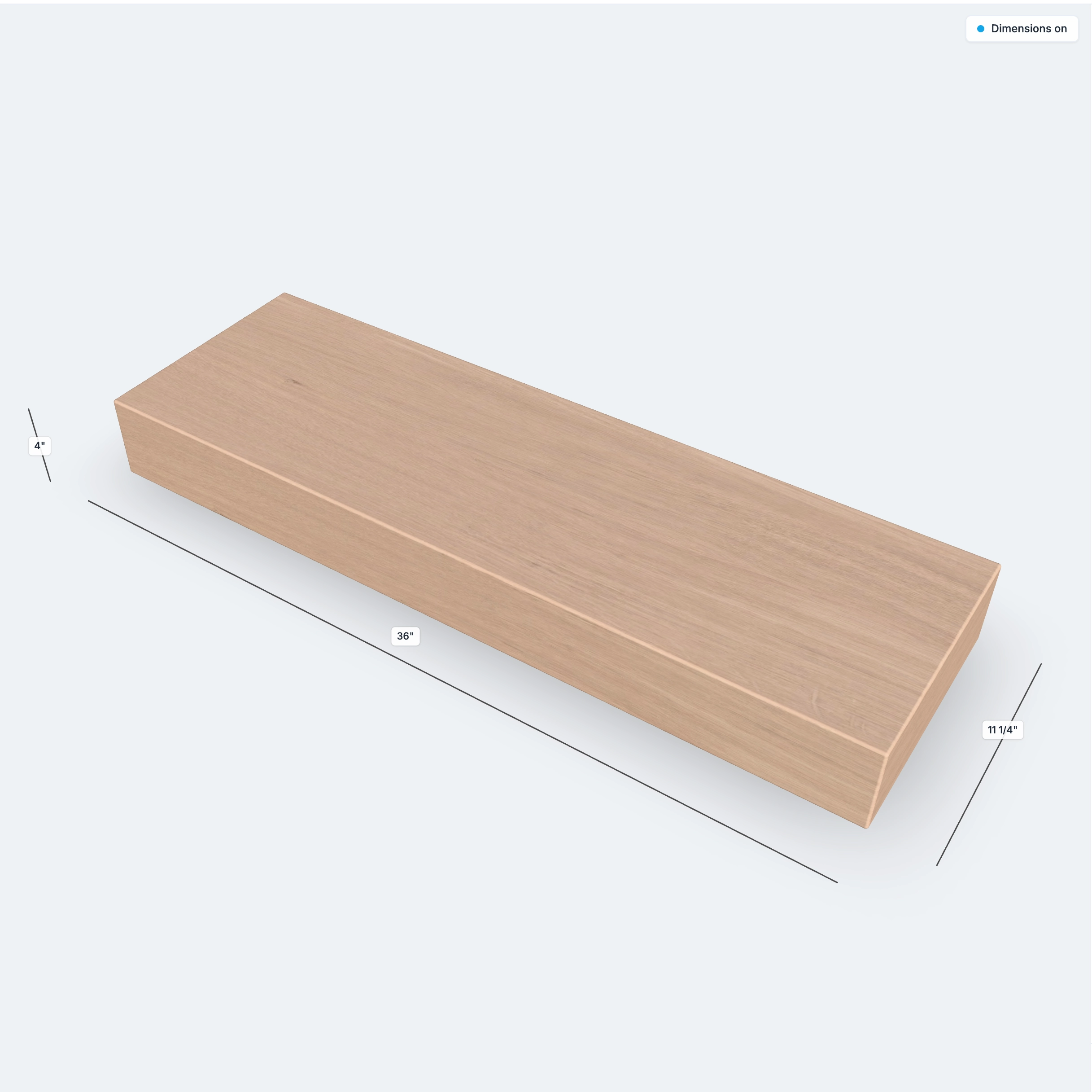
A return is extra material on the left or right of the tread body that overhangs into open space, rounded to match the bullnose at the front so the edge reads as finished. Each return is 1 1/4 inches and sits outside the tread width. A 36 inch tread with returns on both sides measures 38 1/2 inches overall. Order on the left, right, or both sides.
Rectangular wooden plank with dimensions labeled: 36 inches long, 11 1/4 inches wide, and 4 inches thick.

Build your tread and see the price

Build your tread and see the price

Build your tread and see the price

Build your tread and see the price

  • Set species, finish, thickness, and exact dimensions
  • Watch it update on a live 3D preview
  • See your price change as you go
  • Add it straight to your cart
  • Available for all five tread types
Almost every tread we make is produced to order, so there is no shelf to pick from. The Custom Tread Builder is the fastest way through that. Configure the tread you want, see it rendered, and get a price without waiting on a quote. If you would rather talk it through, a representative will get back to you within one business day.

Frequently Asked Questions

What wood species can I choose?

Eight North American hardwoods. Red Oak, White Oak, Quartersawn White Oak, Hard Maple, Hickory, Ash, American Cherry and Walnut. Red Oak, White Oak, Hard Maple, Hickory and Ash take any of our stains as well as a clearcoat. American Cherry, Quartersawn White Oak and Walnut are offered in a clearcoat only, so their natural color carries the run.

What thicknesses and sizes are available?

Standard profiles are 2 inch, 2 1/2 inch, 3 inch, 3 1/2 inch and 4 inch. Common widths run from 36 inches to 72 inches. Depth is set by code before preference: a tread cannot be shallower than 10 inches, and most runs call for more. If you need something outside the standard sizes, the Custom Tread Builder takes an exact length, depth and thickness.

What is a tread return?

A return is extra material on the left or right of the tread body, designed to overhang open space. It is rounded to match the bullnose at the front of the step so the edge reads as finished rather than cut.

Each return is 1 1/4 inches wide and sits outside the tread width, not inside it. A 36 inch tread with returns on both sides measures 38 1/2 inches overall. Order them on the left, the right, or both sides.

Can I order treads unfinished?

Either. Order them unfinished if you want to match existing floors on site, or have us apply a stain and clearcoat in our finishing room. Physical finish samples are available before you commit.

How much do stair treads cost?

Price depends on species, finish, thickness and the dimensions you need, so there is no single per tread figure. Custom routing on FLIGHT treads adds to it as well. The Custom Tread Builder prices your exact configuration as you change it, which is the quickest way to a real number without waiting on a quote.

Where are Viewrail treads made?

At our facility in Goshen, Indiana. We mill, glue, sand, rout and finish each tread in house, then ship it directly to you.

Should I use the shop or the Custom Tread Builder?

Almost every tread we make is produced to order, so there is no genuine off the shelf option. The Custom Tread Builder is usually the fastest route: set the species, finish, thickness and exact dimensions, see it on a live preview, and add it to your cart. If you would rather talk it through, a representative will come back to you within one business day.

What are Viewrail treads made of?

Our Standard and Signature treads are built on an engineered internal core with a hardwood wear layer over the top. The core is what keeps a wide tread flat through seasonal humidity changes. The wear layer is the species and grain you see and walk on, and it runs to a similar thickness as hardwood flooring, so it can be refinished.

Which species holds up best?

Hardness is measured on the Janka scale, and any species rated 900 or above stands up as tread material. Hickory is the hardest of the domestic hardwoods and a common choice for high traffic areas.

Hardness is not the only consideration. Grain pattern varies: Hickory and White Oak are well defined, Hard Maple is milder. So does color. Hickory and Walnut carry high variation and character, while Hard Maple and Oak read more evenly toned.

What finish is on the walking surface?

Walking surfaces are finished with a conversion varnish, the same coating used in the hardwood flooring industry, because it is built for heavy use. Handrails and other frequently touched parts get a pre-catalyzed lacquer instead, which is made to stand up to the natural oils on your hands. Either surface can be refinished later on.
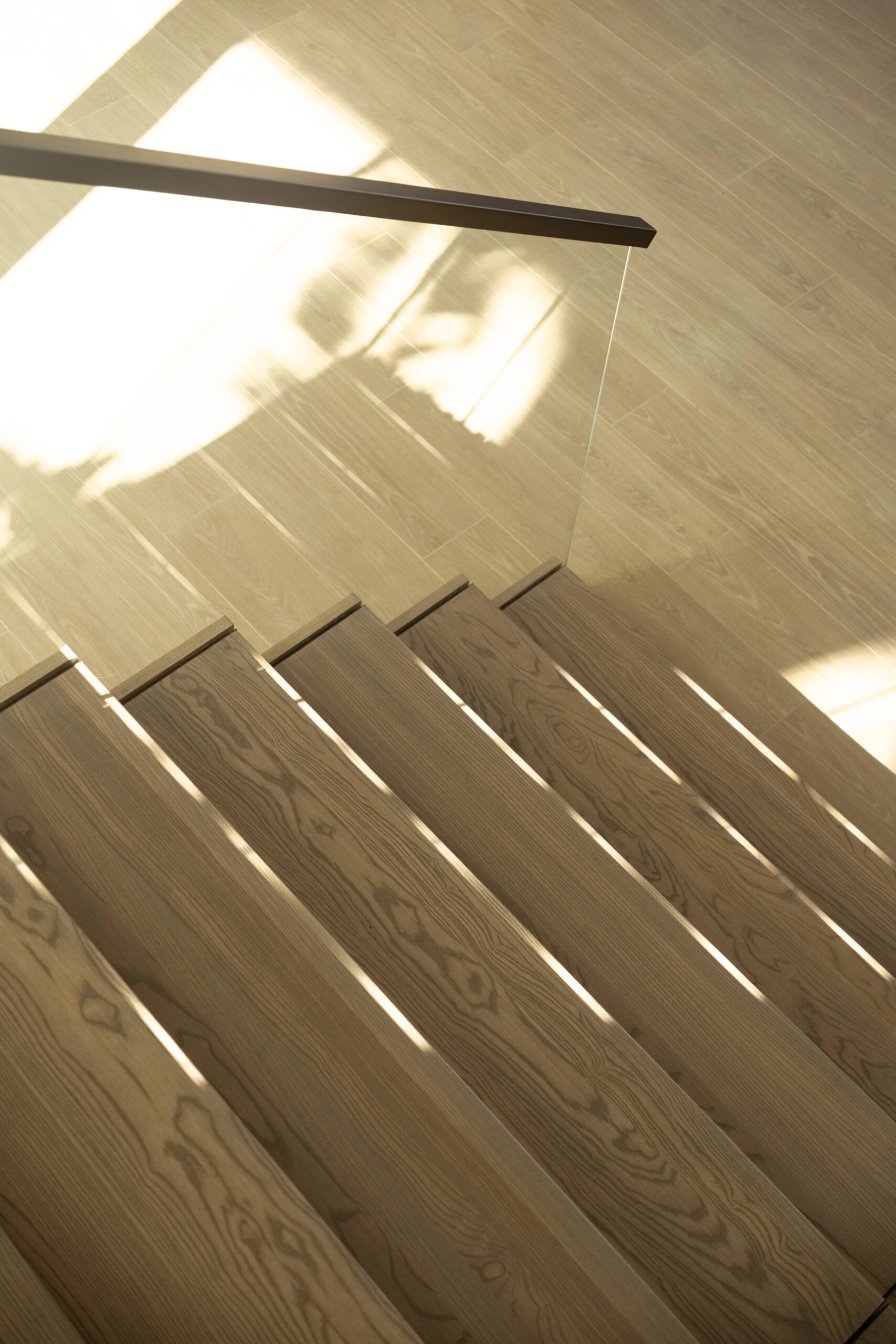
Sunlit wooden staircase with natural grain pattern and a glass railing casting shadows on light wood flooring.

Start where your home begins